Shaping your toddlers behavior

“Stay close to, Mommy!” I say loudly after my toddler who is tearing ahead of me. I grab ahold of her hand and she yanks it down with an assertive “No!”. I drop down to her level and say calmly “If you want to walk by yourself, then you stay close to mommy. If you run away, then mommy picks you up.” She walks next me for a brief moment, then bolts again. I scoop her up and amidst her protest cries I say “Oh, you’re very disappointed. I’m sorry, but I have to help you stay close and be safe.” I model some deep breathing and continue on our way

When we get to our destination, I place my toddler back on the ground and say again “If you walk by yourself then you stay close to mommy.” She walks beside me for a minute and I say “Look at you, staying close to mommy! Thank you.” I continue this pattern of a corrective action for not staying close and praising her when she does a couple of times, before she ends up in the cart the rest of the trip. She’s not happy, but these feelings will pass. I comfort her and we move on. It can feel pretty exhausting, but I know this hard work now has benefits in the long run.

You see, I am using consequences to support my toddler’s developing behaviors. There’s behavioral science behind what I am doing, a rhyme to my reason. Remember behavioral science tells us, that consequences are just the things that happen right after a behavior. There is a misconception in the gentle parenting world, that we don’t use “consequences”. That is completely false information. Remember we’re gentle parents, not PERMISSIVE!

So, let’s break it down a little further. A consequence that makes a behavior happen more often is considered a reinforcement. A consequences that makes a behavior happen less is considered a punishment. (That’s the scary word I think we are trying to avoid, but remember we’re grounding ourselves in science for this activity). I use both reinforcement (praise, letting her walk again) and punishment (“If/Then statement” and the corrective action of picking her up).

So, if I go back to the example mentioned above, I can see that when I praise my toddler “Look at you, staying close! Thank you.” That consequence is hopefully a reinforcing consequence. A simple thank you and recognition, is intended to reinforce her behavior of staying close. I have to strategically provide reinforcement for behavior I want to see more of. It’s science!

Eventually I don’t have to praise it every time, it becomes a behavior that reinforces itself. My little toddler’s brain says to itself: “When we go shopping we stay close to Mommy, when I stay close to Mommy, I get to walk the whole time. I love walking the whole time!”  

On the flip side, let’s talk about the consequences in hopes of decreasing the running away. This would be the scientific term of “punishment”. I like logical consequences as punishments (or consequences that reduce the behavior) The first logical consequence I used was the “If/Then” statement. The intention is this phrase will make the behavior of running away happen less. (Yes, punishment is just a statement sometimes! See, I told you we used consequences!)

However, I like mentioned above, I found out that she seemed to enjoy running ahead of me and chasing her, while using my if/then statement. That’s why I resorted to the corrective action of just putting her in the cart. This stopped the behavior from happening completely.

It seems I have to recalibrate to find a different response to decrease the running away, that probably includes me NOT chasing her (something I don’t really want to practice in Target, perhaps a park would better place to try a different approach). 

My top 3 tips for using consequences

  1. Be quick to spot patterns. We pay close attention to our kiddo, what do they like, what do they want, what makes behavior happen more, what seems to make it happen less. When we spot patterns quickly we can adjust quickly.
  2. Adjust and act accordingly! If we notice something we are doing or saying is making a behavior we don’t want to see happen more, we may have to lean on a more corrective action or more reinforcement of what we do want to see.
  3. Practice a lot! Behavior change takes time and patience. Remember that toddlers and young children are wired to test boundaries, push limits, and develop independence! Practice when you can remain emotionally constant and consistent.

Parenting is a balancing act, and even with experience, I’m still learning. If you’re juggling approaches to address behavior, let’s create a game plan together. Schedule a free call to start with curiosity, connection, and consistency.

The Behavioral Trap: Breaking the Cycle and Encouraging Positive Behavior

Have you found yourself in a behavioral trap, where you are seeing more tantrums, melt downs, hitting, or some other negative behavior? You found a quick way to get the behavior to stop or not last as long, but it seems to be happening more and more? You’re in a behavioral trap. If you want to reduce how often the behavior is occurring then you have to approach with a strategy!

Approaching positive behavior is rooted in behavioral science for me. When we want to see more of a behavior, we have to reinforce it. I’m not talking about a reward chart for every behavior, but more like making sure that you are creating an environment for positive behavior to grow and prosper. You need to teach and model it, support it happening, and reinforce it when you see it! It’s really that simple.

Just like any skill like walking or talking, the skills of positive behavior need to be taught and modeled. The easiest way to do this would be to narrate your day, what you are doing, how you are doing it and why you are doing it. It can sound like “Uh oh, I spilled all these pencils, let me pick them up so I can help take care of our house.” Or “Daddy is helping, Mommy and I don’t like how he is helping me so I am going to use my words and say “No, thank you!” If narrating feels like too much you can slow down daily tasks and say something like “Look how mommy cleans up these toys. Can you help me?” Remember we are raising children in a “Do as I do household”.

When we’re talking about supporting positive behaviors in happening, we mean making it easier for positive behavior to occur. If we know that getting dressed is challenging, we do our best to embed choice, make it fun, or make it quick. If we know transitions are hard, then we give reminders, use countdowns, or make the transition from one activity to the next more fun.

When we see our kiddo engaging in a positive behavior we need to reinforce it. The simple act of just using specific positive praise is super useful in stamping positive behavior. When you are seeing your child and connecting them in moments of postive behavior, they don’t have to rely on negative behavior to serve that same function. Think about it this way, if you have long drawn out conversations when your child hits, but when they come over to you and try to engage you ignore them, you’re saying “I don’t see you when you are doing the right thing, I can only see you when you are doing the wrong thing.” That’s the message.

Curiosity, Connection and Consistency: Reducing Your Toddler’s Hitting

Photography by Lewisburg Studios

It is so easy to get flustered by o ur toddlers hitting. There is so much conflicting advice out there around hitting. Honestly, if there was a one size fits all approach to hitting we’d all be super grateful and rich as hell. Unfortunately hitting is deeply unique to our toddlers and their desires, wants, needs and personality. The reason your toddler is hitting is going to be different than the reason my toddler hits. The one thing that is true for most parents is that hitting is triggering. When we’re triggered we are likely to jump into our authoritarian parenting who wants to just control hitting. “OH HELL NO! YOU DON’T HIT ME! I’M THE PARENT!” We can often resort to yelling, ignoring, and even spanking in response to hitting behaviors.

Those responses may stop hitting temporarily. At the end of the day, that hitting is just a form of communication, how we respond to it often determines if it will continue to happen or not. If we want to see actual behavior change like the hitting behavior happening less and a better form of behavior happening more, then we have to start from a place of curiously, connection and consistency.

We have to remember that hitting is a form of communication from our toddlers. They aren’t hitting to cause to you (that’s too advanced for a toddler). They are hitting because they have some need they want to communicate. The function of my toddler’s hitting is going to be different than your toddler’s hitting. This could be a need that isn’t being met like desiring your attention, or feeling hungry. It could be hitting to express a want like in response to having an item taken away. Sometimes there is an automatic need like when your toddler is super mad and hits because they just like the sensory feeling on their hands.

Curiosity: We start by asking ourselves curious questions.

  • What is my toddler trying to tell me? Do they want attention from or from someone else? Do they want something? Do they want to get away from something?
  • What could they need in this moment? Is there a basic need not being met? Could they be hungry?
  • What big feeling could be triggering this? Are they excited? Are they mad about

Curiosity means asking questions in an attempt to understand what the function of the behavior could be. Every behavior has a function. We start investigating hitting so that we can make informed decisions and conscious choices about how we respond.

Curiosity: We look for patterns, all behavior happens in ABC patterns.

  • Antecedents: The thing that happens immediately before the hitting behavior. What happens right before your toddler hits? Are you in your phone? Did you take something away? Does someone have something they want? Are you getting dressed?
  • Behavior: Is the thing our toddler actually does. Sometimes there is a pattern here. Maybe your toddler yells right before hitting. Maybe hitting happens in a chain of behaviors like a tantrum.
  • Consequences: just the thing that happens right after the behavior. It could be you responding to the hitting like through yelling, saying “No!” Or having a one on one talk. It could be them getting something taken away or picked up. It could be getting ignored after the behavior. It could be another kid hits. It’s just the thing that happens after.

Behavioral science tells us that we have to look at the things that happen right before behaviors and right after to be able to create change. We call these the ABCs of behavior. Antecedents, behaviors and consequences. Don’t get stuck on this word “consequences” in behavioral science this just means what happens directly after the behavior. Some consequences are reinforcing and then behaviors happen more, some consequences will make the behaviors happen less.

Connection: We keep our reactions to hitting small.

  • Low quality attention: When we react small to hitting we are providing low quality attention. We use a low tone and stick to a short phrase. “Hands are for being kind or safe.” “I’m not going to let you hit me.”
  • The purpose of low quality attention is to limit the possibility of it being a reinforcing type of attention. If hitting gets a big reaction out of a parent like a big loud “WE DON’T HIT” or a long drawn out one on one conversation, it can turn into a reinforcement for the hitting. Essentially, “If I hit, my parent pays attention to me when they weren’t before!”

Connection: We reinforce the behavior we want to see from our toddler.

  • We notice when our toddler is using kind and safe hands. We name it clearly and consistently. “I love how you are using kind hands to help mommy clean up.” “Look how safely you gave me that toy with your hands.” “Wow, you didn’t get a big feeling when Mommy said no!”
  • We reinforce the attention seeking behavior we want to see. If the only way our toddlers can get our attention is by hitting, then the hitting is going to continue. It serves its purpose. In order to counteract the hitting, we need to celebrate and acknowledge appropriate behavior for getting our attention. When your toddler says your name you can simply respond the first time. “Oh, thank you for using my name, what do you need.” or “I hear you saying my name, let me finish this last thing and I’ll help you right away.

Being a connected parent means we are making sure our toddler feel seen and valued. That we love them even when they make mistakes and we see them doing the right thing. Connection is the pillar that keeps us less likely to be triggered too. Low quality attention and reinforcing positive behaviors help keep us grounded and sane. This parenting thing is so freaking hard.

Consistency: We stay consistent when we respond to hitting.

  • When we’re trying to figure out how to best respond to our toddler’s hitting we pick a response and stick with it. The more consistent we are with our responses the more we can pick up on the frequency of hitting. Is it happening more or is it happening less. If we switch up our responses too quickly we can make the behavior way harder to change. It’s just the science of behavior change.
  • Sometimes we’re going to get it wrong and we’re going to have to try a lot of different things on. If we’re noticing the behavior is getting more frequent we adjust our approach. If we notice it’s getting less frequent we keep that response consistent.

Pro tips: You can use this same approach when thinking about hitting at daycare and school. As a parent you can probe the teachers and care givers for more information around why they thing your toddler is hitting, or what patterns are happening when the hitting is happening (curiosity) You can ask how they reinforce the behavior they want to see from your toddler and that they only use low quality attention (connection) You can share your response plan and ask them to give it a try. (Consistency).

My name is Alyssa Conti Hampton. I am a toddler mom who also happens to be a behavior analyst and special educator of 15 years. I’ve dealt with tricky behavior in a variety of shapes, forms and sizes for almost two decades. This parenting thing is hard, even when you’ve had years and years of practice. I’m not perfect, but I’m going to continue to support my toddler with curiosity, connection, and consistency. Follow along as I make the most of motherhood.
Choice and No Choice: Language to Support Flexible Thinking

I’m making an effort to support my toddler in being flexible in her thinking and not get stuck or fixated. By making some conscious shifts to my daily language I can support the part of her brain that develops executive functioning. That executive functioning part of our brain is where we remain flexible, adapt to change, and problem solve. By intentionally teaching language around choice and no choice to my toddler, I am supporting her ability to be a strong problem solver and decision maker even during heightened emotions. (This is a skill set, I still am sharpening as an adult.)

I want to be clear with my toddler that some decisions she gets to make and some she doesn’t. You have to remember that between the ages of three and five, toddlers and young children are developing their autonomy and independence. It is our job to give them opportunities to assert that independence and autonomy but also develop clear boundaries, so they’re less likely to act out.

When Maddox doesn’t get to make a decision, I tell her something is a “No Choice”. I started this really young, specifically when she would protest her diaper change. “Oh, I know you don’t like getting your diaper changed, but this is a no choice activity. We have to do it.” If the no choice is something that has to get done, like clean up, wear a coat, brush your teeth, there are either corrective actions or boundaries set if you refuse. For example the boundary set could be: No outside time without a coat, the corrective action could be: Mommy does it for you!

When Maddox refuses a coat this sounds like “Wearing a jacket is a no choice, we have to put our coat on to stay warm. Mommy will help you put it on so we can play outside” (corrective action) or “Wearing a jacket is a no choice activity, we have to put our coat on to play outside. First our coat then outside.” (Boundary set)

The only way choice and no choice language works if it is paired with actually getting to make choices independently. I look for opportunities to plug in a lot of choices for Maddox to make so she develops her sense of autonomy. On the flip side, I don’t overwhelm her with choice (not everything is a choice). What books you read, what toys you play with, which shirt to wear, or choosing something to eat. Those are things that you can have choices in.

Using choice language and weaving choice into every day makes the in the moment battles less emotionally triggering for you and your toddler. Intentionally teaching into this concept of choice and no choice will help your toddler with thinking more flexibly, adapting to change, and problem solving improve as they grow and get older.

Emotional Constancy

Today’s topic is emotional constancy. This is a phrase you’ve probably heard in the world of education, but it is equally as important in parenting. Emotional constancy is being emotionally consistent, being predictable, in how you respond to your own heightened emotional states and then how you show up for your toddler in those moments. You are not meeting big emotions with big emotions. You as the adult, are regulating yourself. You’re going to lend your calm to your child when they are experiencing big emotions.

Brain science teaches us if you’re in a heightened emotional state, your brain is usually in more of a survival mode. Survival mode is where the fight flight, freeze, or fawn response comes in We don’t want to be in a survival state when we are supporting our toddlers in regulating, we want to be in a state in which we can make smart choices and planned decisions.

Remember, that you are the model for your child. If you are not modeling what you want your child to be doing and showing them how to do the things you expect them to do, you’re doing it wrong.


You have to lead by example. Every moment with your toddler is a teachable moment. Every moment that you are utilizing a strategy, practicing or modeling for your kiddo you are leading by example. You’re providing an exposure to that process. This exposure is helping synapsis is form in the brain.

The thing about being able to show up emotionally constant for your toddler, is it’s going to take some initial pre-work. You’re going to need to be able to identify your own triggers. Understanding what causes you to become in a heightened emotional state. After you’ve identified the trigger you can also think about what is the story that I’m telling myself about this behavior or about this reaction that’s causing me to feel so triggered? Remember, it’s not about your kiddo and what they’re doing to you, it’s about the story you tell yourself after they do that thing.

It’s easier to understand this when we think about it in terms of an adult. I asked my partner to put away their clothes. I left the laundry basket on their side of the bed, and for two days, the basket get moved to the floor and then right back on the bed. It’s starting to cause some tension because the story I’m telling myself is they don’t respect me as a partner. “They don’t listen to me. They don’t hear me, right?” It’s the story that I’m telling myself about that trigger that is causing the heightened emotional state. You should have some go-to emotional regulation techniques and strategies for yourself so that you can bring yourself back down to a, an executive state.

How to Model Emotional Constancy
How do you maintain emotional constancy even when you’re in an emotional state? There are a couple areas that I push myself in when I need to remain emotionally constant or I feel myself getting triggered.

  1. Take a Deep Breath– The first thing that you can do to remain emotionally constant is just take a deep breath, breathe in and out before you determine how you’re gonna react. Slow your brain down for a second. Remember, again, you’re modeling. This is a, I’m modeling how I take deep breaths to work through, um, heightened emotional states.
  2. Get on the same level– I get down on her level or I pick her up to my level. I want to be able to support her heightened emotional state. If I am above her and not on her level, it is going to be more difficult to stay emotionally constant.
  3. Cue your Calm– After I take a deep breath, I cue myself by saying: “Hey, listen” I’m queuing her into the fact that we’re about to regulate. I also use the cue for myself as a way to get my bearings about me.
  4. Control Your voice– I talk very slow and softly. I’m not gonna meet her heightened emotions with my own yelling or big reactions. I need to lend her my calm.
  5. Pause for processing– It’s really easy to talk really, really fast when you’re in a heightened emotional state.Your toddler will then not be able to process what you are saying, due to their heightened emotional state. I pause often to allow her to process. When I do that, I’m helping her little language, developing brain, be receptive to receiving what I’m saying. I want her to be able to hear and process what I’m asking her or what I’m telling her in that moment of co-regulation. I’m helping her come back down to a more of an executive state rather than her little survival state.
  6. Practice- I recommend that you are practicing emotional constancy and naming when you’re being emotionally constant. “Mommy’s taking her deep breaths right now.” “Mommy’s gonna listen to some music, which helps her not feel so sad”. Mommy’s gonna move her body so I can better manage my big feelings”

Your toddler is learning from you, absorbing what you’re doing, They are seeing and observing how you’re acting, how you behave day in and day out. When you remain emotionally constant or emotionally consistent and you model emotional consistency for your toddler you are laying the foundational ground work for self-regulation and emotional intelligence.

Dealing with NO!

1

My toddler, like every developing toddler is saying no a whole lot. Fact, toddlers are developing autonomy and independence, learning they have their own will and “power”. While flexing this new autonomy’s muscle they will also start to experiment with lying. Like when you catch them with chocolate in their mouth and you ask if they took any and they say “No!” 

Let’s imagine you just want your toddler to clean one activity up before moving on to the next.  However, your toddler just wants to do what they want to do. When you say we have to put the puzzle away before we can read together, your toddler lets out a big “No!” Crossed her arms and digs in!

Here’s how to handle it:

  1. Breathe and think of your expectation– Breathing is our self regulation tool, the tool we lean on to stay emotionally constant. While you’re breathing you’re thinking about how to best approach this refusal. Asking yourself “what is my boundary? What is my nonnegotiable in this moment?”
  2. Set the boundary warmly and firmly- We don’t need to raise our voice with our children to get them to listen, but we can put the firmness into our voice. Restate your boundary or expectation.  Pro tip: try a “first/then” statement. “First, we clean up the puzzle, then we can read books”. 
  3. Wait and offer co-regulation if needed– Offering wait time, sets the tone that we know you can meet the expectation. If your toddler is becoming increasingly upset offer co-regulation. You can tap into those naming and validating skills. Remember an emotionally heightened brain isn’t going to be able to make good decisions. 
  4. Help and model- When my toddler digs her heels in and is just giving me a hard time. I usually offer my help: “It looks like you’re having a hard time cleaning up, mommy will help you.”  Then model what ever was refused or offer hand over hand help,  which is exactly what it sounds like your hands over their hands guiding your toddler to participate.
  5. Praise as soon as the behavior changes- Praise is such an important tool for everyone. When we praise we are reinforcing the behavior we want to see more of. If all of our attention is on negative behaviors then we are reinforcing those negative behaviors rather than the great behavior we want to see. 
  6. Stay consistent but considerate- As important as it is to stay consistent, it is also important to remember that your toddler is still learning and growing. They are going to need us to support them in making good choices and doing the right thing. Sometimes that you means you pick them up and co-regulate with them, sometimes it means you take the item away, and sometimes it means you hold firm. You know your child best and you know how to best support them. 

If you notice your child is refusing more, start paying attention to how you are reacting. Are you staying consistent or are you too flexible? Are you providing more attention for refusals then when they are doing the right thing? 

Toddlers are looking for us to help them develop their autonomy and independence, this is going to come with a lot of “NO’s”. Try these tips and see how they work for you! 

Boundaries and Toddlers

Let’s talk about boundaries and toddlers.

When I say “boundaries”, I’m talking about expectations, rules, and structures. They let toddlers know what is acceptable and what isn’t. It’s the best way to prevent meltdowns and tantrums.

Clear consistent boundaries and expectations are one of the most powerful tools we have to support child development. If the environment is predictable, if the environment is consistent, if the environment is clear, we are less likely to see problem behavior.

If sometimes it’s ok to hit and sometimes it’s not, that can get really confusing especially to a developing toddler.

Let’s put it into adult perspective. On Monday you missed a deadline and your boss says “It’s ok. We’re flexible here”. Then the next week you miss a deadline and your boss writes you up, you’re going to feel some type of way. That feeling is probably confusion and resentment wrapped together. “Why was it OK on Monday but today it’s an infraction?” The same is true for a toddler or child. When something is ok one day but not the next, you’re going to create some frustration and confusion which may cause more acting out.

My two biggest rules or boundaries with Maddox right now are:

1. You have to be safe

2. You have to be kind.

These rules are two rules we can always follow, especially when dealing with big feelings. We can have all of the big feelings that we wanna have. You can be mad, you can be upset, you can be angry, you can be resentful, you can be jealous or you can be embarrassed. What you can’t be is mean or unsafe.

Setting the boundaries in action

  1. Model and uphold the boundary yourself. Which means, if I am in a disagreement with my spouse, I need to make sure I’m modeling for my daughter, staying within that boundary. I’m not slamming doors, I’m not name calling, I’m not shaming, I’m not breaking stuff. I’m not yelling. I am safe and I am kind even when I am mad or in a conflict.
  2. Teach and explain the boundary. We teach what it means to be kind and safe through books and play. I also use my language. Throughout the day I am stamping boundaries in action. “Look how kind Daddy is being helping me clean up!” “Do you see Elmo taking deep breaths, he’s so safe when he has big feelings” We love the book “Hands are not for Hitting”
  3. Praise the boundary. Your kiddo needs you to stamp the boundary for them. We want to encourage the behavior we want to see. The same is true for upholding boundaries. “Oh you picked up that trash for Mommy, so kind” “I love how you slid down the steps on your bottom, that’s a safe way to go down”
  1. Immediately name when a boundary has been crossed. I truly believe you can and should name boundaries when they are crossed even during co-regulation. “You hit Mommy, that’s not kind.” “You’re throwing your body back, that’s not safe.”
  2. Offer an alternative or choice. When the boundary is crossed we can offer an alternative way to react or do something. We can also offer a choice in the moment. So if Maddox is mad and hitting. I can say “We can take deep breaths when we’re mad or we can give hugs to help us feel better when we’re mad.”

A note about co-parenting and boundaries

If you’re co-parenting you are going to have to come together and create cohesive boundaries especially as children get older. Are you guys on the same page about what the boundaries are? When you find an area where the boundaries are inconsistent or unclear or you have a different opinion about what the boundaries should be, you guys have to have a closed door conversation. Remind yourselves, it’s not about you it’s about your kiddo.

I will say you can have different boundaries in different settings or with different people, but you’re going to need to teach into that. An easy example is yelling. When we’re outside we can be loud and make a lot of noise, but when we’re in the store we have to use a quieter voice. The same can be true

Toddlers are observant. They are watching us day in and day out to see what is acceptable, what isn’t. They will test boundaries and they will push the limits. This is completely normal. Remember you’re being watched when it comes to boundaries so be the example. Do as you want your little to do. Stay consistent. Stay clear on what is acceptable and what isn’t.

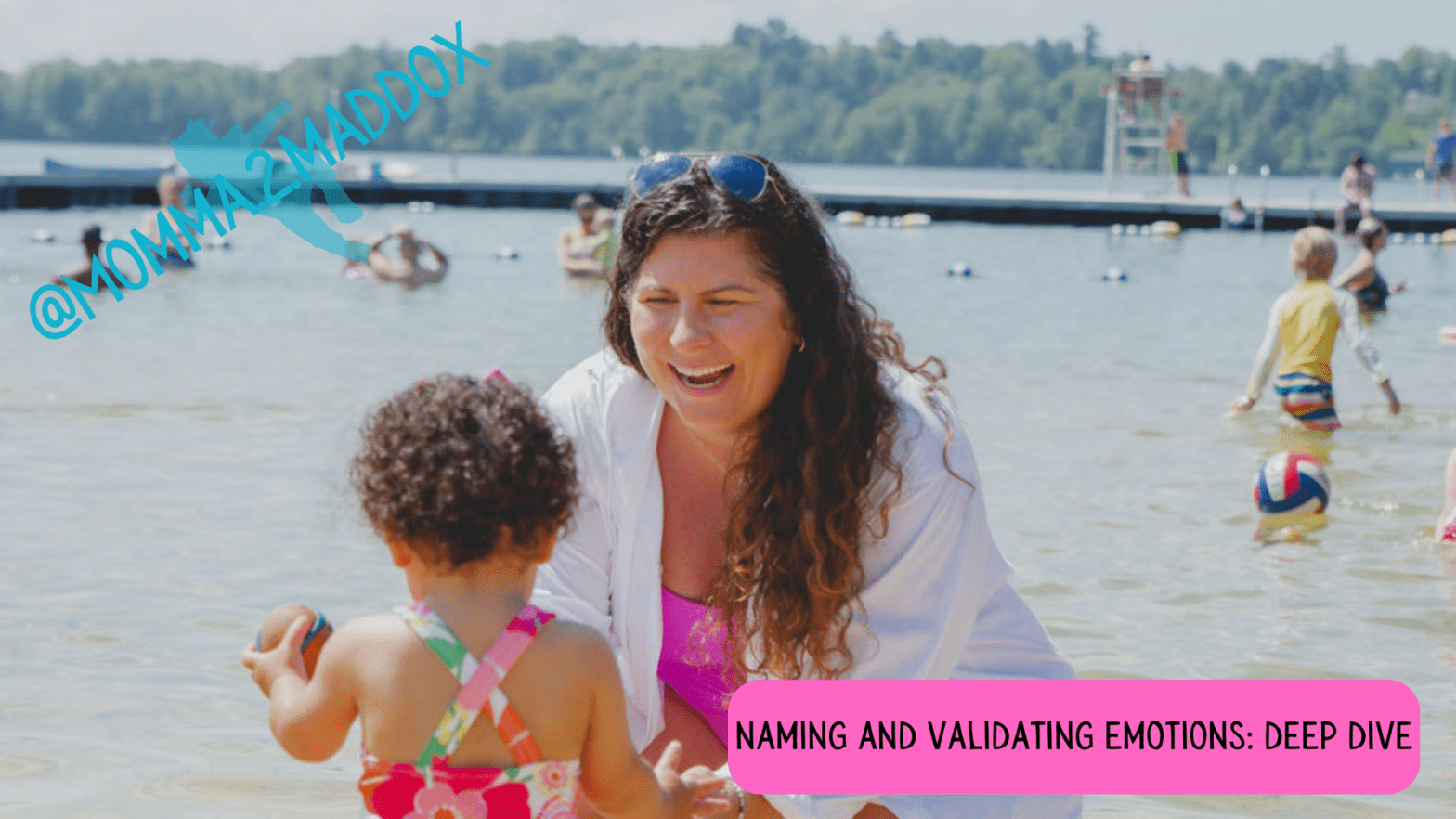
Naming and Validating Toddler Emotions- a deeper dive

So how does the whole naming and validating work?


So let me give you an example, with Maddox, my daughter. Maddox wants to go outside, but it’s raining and about 40 degrees so obviously going outside isn’t an option. She’s having a cry, maybe there’s some screaming or body throwing, maybe she hit me.

1. The very first thing I’m going to do is breathe in an out. I cannot support her if I am not actually regulated myself.

2. I’m going to drop down to her level, I’m going to lower the volume of my voice and slow down my cadence. I can’t meet her big emotional reaction with my own big reaction. I need to model how we handle big emotions.

3. I’m going name what I’m physically seeing or what I think she could be experiencing. I do this so she can start to recognize when she experiences big feelings. “I see you’re crying, I see you’re throwing your body down.”

4. I’m going to pause between statements. Her brain is processing and when we’re upset it’s much more difficult to process language.

5. I’m going to start building her emotional vocabulary by labeling her emotion. “I can see you’re really frustrated that we don’t get to go outside. I feel frustrated too.”

6. Provide validation. “It’s ok to be frustrated, Mommy gets frustrated too!” I say that because, I need her to know what she’s feeling is normal and okay, I don’t want her to associate big feelings with negativity.

Naming and validating emotions for your toddler can support developing emotional intelligence. Remember that toddlers are experiencing the world for what feels like the first time every day. It can take a thousand exposures to something to create synapsis in the brain. So the more frequently you are naming and validating emotions. The more exposures.

The other piece is helping your toddler make sense of their emotions, help them understand their own emotions. Toddlers are exploring emotionality and they are looking to us to decide, is this emotion a good emotion? Is this a bad emotion? Like, what is the deal, Mommy? As for naming and validation, I actually do it for my own self-regulation too. This is a type of modeling. If you are not modeling for your child what it looks like to self-regulate and have self-control then you are missing the mark. You are basically saying “do as I tell you, not as I do” which is extremely confusing for toddlers navigating the world.

When I reminisce my own emotional upbringing, I was nurtured deeply by my parents, but growing up my feelings were not often validated. I developed a self-talk script that I was too dramatic, or acting like a hypochondriac. You grow up thinking how you are feeling is wrong. So you push down any emotion you think is bad. When you, as the parent or adult, negatively narrate emotions with your toddler you’re developing their own negative self- talk. (ie.”I’m too dramatic! This isn’t a big deal!”)

Let’s make the most of parenthood by using naming and validating as a way to support emotional intelligence!

Flying with Baby!

Our first solo flight! Baby girl was 5.5mo!

Flying with a baby can feel super intimidating but here are some ways that flying with my baby has been made a little simpler.

1. Car seat recommendations: I’d recommend buying the cosco Scenera (not sure if it’s available in Canada, but you can get it here at Walmart for $50.) It weighs 8lbs and is approved for airplane use (if baby has their own seat) It has a super easy seatbelt install both for plane seats and in cars. We have one and 10/10 recommend for travel. It’s also super durable.

You can also rent a car seat through car rental agencies and request Ubers and Lyfts with car seats. Just check weight limits and make sure baby will fit in the requirements.

2. Checking bags: You can check a car seat and stroller for free as assistive devices. Buy large travel bags from Amazon and stuff with diapers, blankets and soft items you will need (to protect them from damage). When flying home you can stuff all your dirty laundry in there.

3. Getting through security: TSA pre check is a game changer. It is worth the fee. You get to keep your shoes on and you can wear baby. If traveling with pumped breastmilk or formula, prepare a few bottles ahead of time be prepared for extra time at TSA to test bottles.

4. Getting around the airport: I prefer baby wearing in the airport, but I’ve only flown non-stop. I believe that if we had a layover or baby was a little heavier, I’d prefer the stroller. Just remember that if you’re flying solo with baby, you have to break down the stroller to gate check it.

5. Packing essentials: Use a diaper bag backpack with everything you need, you will need all your free hands. Pack extra clothes for you and baby. Blowouts can happen on planes. Bring a new toy and a favorite toy so baby has something to play with if awake during flight. Bring easy snacks and foods if baby is eating solids.

6. Right before your flight: Change baby’s diaper before and after flight, on plane changing tables are tiny and hard to navigate. This way you can also use the restroom, change clothes or do whatever you need to.

7. Board Last: Yes you can get early boarding with a baby, but I promise boarding last is the way to go. It is way easier then sitting on the plane for 30 minutes entertaining your baby while everyone else boards.

8. While flying: Feed, (breast or bottle), or paci during take off and initial descent to help with ear pressure. If baby is asleep it might not matter.

9. Stay calm: You got this. Baby will feed off your energy, it will be way easier than you think! If baby is fussy or cranky, it’s all good you paid to be there, just like them.

Mastering the Crib Nap

Tips that helped our little one sleep independently in her crib, in her room.

I might be the lightest sleeper ever. I wake for every little movement and noise. Room sharing with our baby was so hard for me, I was up every hour peering over the side of the bassinet to check on my baby girl. Baby girl is a mover and she would thrash and hit the sides of the bassinet waking her self up. It was getting to be too much and I knew I wanted my baby to be able to sleep independently in her own space. I focused in on crib naps as a way to introduce her room and crib. Now at 15 weeks, our LO sleeps in her crib in her room independently. I want to note that the AAP recommends room sharing the first year of life, but you have to do what works for you and your family.

Tip #1: Playtime and awake time in the sleep space

Your baby should be familiar with the sleep space before going down to sleep. You want baby to be able to sleep in an environment in which they are comfortable and feel safe. You can have some play time in the sleep space and spend daytime in the space so that baby is familiar. If baby is put down in a new space without being familiar with the space, they will not be able to fall asleep.

Tip #2: Create an optimal sleep environment

Once a baby develops their circadian rhythm, around 8 weeks, it becomes more challenging to fall asleep in stimulating environments. By creating an optimal sleep environment you are helping your little one create the melatonin needed for sleep pressure. Black out curtains, a noise machine, and a cool temperature are all ways to create an optimal sleep environment. You want to do a scan of the space and make sure nothing is too stimulating for your baby. When a baby wakes up from their natural sleep cycle, you want them to be able to fall back asleep, if there is too much to look at and too much to hear, babies will have a hard time falling back asleep.

Tip #3: Put baby down awake and fed

I’m sure you’ve heard the statement “drowsy but awake”. The notion behind drowsy but awake, is that baby’s are exhibiting signs and cues of being tired, you may have nursed them or rocked them. You want to set your baby awake in the crib. You can stay close by or leave after you do it. Baby’s that are very tired are not going to have much difficulty falling asleep on their own. Being able to fall asleep without a prop ensures that baby has sleep associations they can do themselves when they wake up. The crib transfer will become a thing of the past. It can be very jarring for a LO when they wake up in their crib when they fell asleep in your arms.

Fed before bed. You want to make sure that your LO has had enough food to fill them up so they can sleep more soundly. Hungry babies do not nap or sleep well at all.

Tip #4: Support Gradually

You want to work your way through a soothing ladder when you notice your little one becoming fussy in the crib. I will have a whole blog post dedicated to responding to crying during sleep. You want to make sure you are utilizing the intervention that is the least supported by the caregiver/parent. You can gradually increase the support you are providing your little one. On the soothing ladder, feeding and rocking/swaying are at the end of the ladder, where as standing near your little one is at the top.