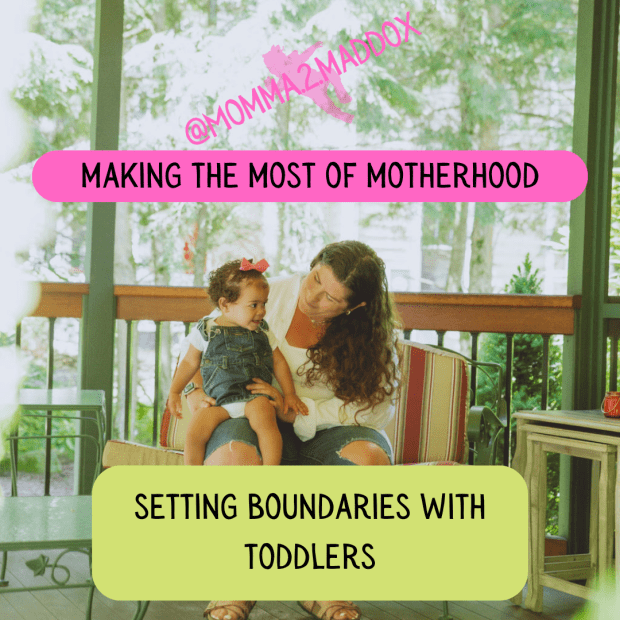
 Let’s talk about boundaries and toddlers.
When I say “boundaries”, I’m talking about expectations, rules, and structures. They let toddlers know what is acceptable and what isn’t. It’s the best way to prevent meltdowns and tantrums.
Clear consistent boundaries and expectations are one of the most powerful tools we have to support child development. If the environment is predictable, if the environment is consistent, if the environment is clear, we are less likely to see problem behavior.
If sometimes it’s ok to hit and sometimes it’s not, that can get really confusing especially to a developing toddler.
Let’s put it into adult perspective. On Monday you missed a deadline and your boss says “It’s ok. We’re flexible here”. Then the next week you miss a deadline and your boss writes you up, you’re going to feel some type of way. That feeling is probably confusion and resentment wrapped together. “Why was it OK on Monday but today it’s an infraction?” The same is true for a toddler or child. When something is ok one day but not the next, you’re going to create some frustration and confusion which may cause more acting out.
My two biggest rules or boundaries with Maddox right now are:
1. You have to be safe
2. You have to be kind.
These rules are two rules we can always follow, especially when dealing with big feelings. We can have all of the big feelings that we wanna have. You can be mad, you can be upset, you can be angry, you can be resentful, you can be jealous or you can be embarrassed. What you can’t be is mean or unsafe.
Setting the boundaries in action
- Model and uphold the boundary yourself. Which means, if I am in a disagreement with my spouse, I need to make sure I’m modeling for my daughter, staying within that boundary. I’m not slamming doors, I’m not name calling, I’m not shaming, I’m not breaking stuff. I’m not yelling. I am safe and I am kind even when I am mad or in a conflict.
- Teach and explain the boundary. We teach what it means to be kind and safe through books and play. I also use my language. Throughout the day I am stamping boundaries in action. “Look how kind Daddy is being helping me clean up!” “Do you see Elmo taking deep breaths, he’s so safe when he has big feelings” We love the book “Hands are not for Hitting”
- Praise the boundary. Your kiddo needs you to stamp the boundary for them. We want to encourage the behavior we want to see. The same is true for upholding boundaries. “Oh you picked up that trash for Mommy, so kind” “I love how you slid down the steps on your bottom, that’s a safe way to go down”
- Immediately name when a boundary has been crossed. I truly believe you can and should name boundaries when they are crossed even during co-regulation. “You hit Mommy, that’s not kind.” “You’re throwing your body back, that’s not safe.”
- Offer an alternative or choice. When the boundary is crossed we can offer an alternative way to react or do something. We can also offer a choice in the moment. So if Maddox is mad and hitting. I can say “We can take deep breaths when we’re mad or we can give hugs to help us feel better when we’re mad.”
A note about co-parenting and boundaries
If you’re co-parenting you are going to have to come together and create cohesive boundaries especially as children get older. Are you guys on the same page about what the boundaries are? When you find an area where the boundaries are inconsistent or unclear or you have a different opinion about what the boundaries should be, you guys have to have a closed door conversation. Remind yourselves, it’s not about you it’s about your kiddo.
I will say you can have different boundaries in different settings or with different people, but you’re going to need to teach into that. An easy example is yelling. When we’re outside we can be loud and make a lot of noise, but when we’re in the store we have to use a quieter voice. The same can be true
Toddlers are observant. They are watching us day in and day out to see what is acceptable, what isn’t. They will test boundaries and they will push the limits. This is completely normal. Remember you’re being watched when it comes to boundaries so be the example. Do as you want your little to do. Stay consistent. Stay clear on what is acceptable and what isn’t.


