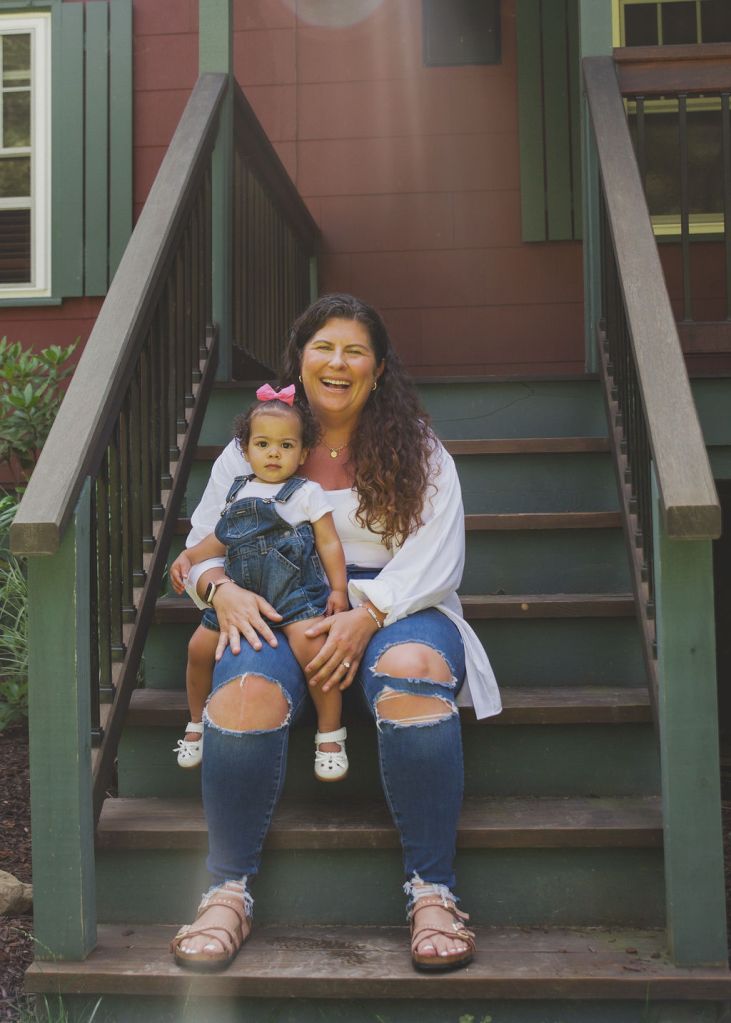
“Stay close to, Mommy!” I say loudly after my toddler who is tearing ahead of me. I grab ahold of her hand and she yanks it down with an assertive “No!”. I drop down to her level and say calmly “If you want to walk by yourself, then you stay close to mommy. If you run away, then mommy picks you up.” She walks next me for a brief moment, then bolts again. I scoop her up and amidst her protest cries I say “Oh, you’re very disappointed. I’m sorry, but I have to help you stay close and be safe.” I model some deep breathing and continue on our way
When we get to our destination, I place my toddler back on the ground and say again “If you walk by yourself then you stay close to mommy.” She walks beside me for a minute and I say “Look at you, staying close to mommy! Thank you.” I continue this pattern of a corrective action for not staying close and praising her when she does a couple of times, before she ends up in the cart the rest of the trip. She’s not happy, but these feelings will pass. I comfort her and we move on. It can feel pretty exhausting, but I know this hard work now has benefits in the long run.
You see, I am using consequences to support my toddler’s developing behaviors. There’s behavioral science behind what I am doing, a rhyme to my reason. Remember behavioral science tells us, that consequences are just the things that happen right after a behavior. There is a misconception in the gentle parenting world, that we don’t use “consequences”. That is completely false information. Remember we’re gentle parents, not PERMISSIVE!
So, let’s break it down a little further. A consequence that makes a behavior happen more often is considered a reinforcement. A consequences that makes a behavior happen less is considered a punishment. (That’s the scary word I think we are trying to avoid, but remember we’re grounding ourselves in science for this activity). I use both reinforcement (praise, letting her walk again) and punishment (“If/Then statement” and the corrective action of picking her up).
So, if I go back to the example mentioned above, I can see that when I praise my toddler “Look at you, staying close! Thank you.” That consequence is hopefully a reinforcing consequence. A simple thank you and recognition, is intended to reinforce her behavior of staying close. I have to strategically provide reinforcement for behavior I want to see more of. It’s science!
Eventually I don’t have to praise it every time, it becomes a behavior that reinforces itself. My little toddler’s brain says to itself: “When we go shopping we stay close to Mommy, when I stay close to Mommy, I get to walk the whole time. I love walking the whole time!”
On the flip side, let’s talk about the consequences in hopes of decreasing the running away. This would be the scientific term of “punishment”. I like logical consequences as punishments (or consequences that reduce the behavior) The first logical consequence I used was the “If/Then” statement. The intention is this phrase will make the behavior of running away happen less. (Yes, punishment is just a statement sometimes! See, I told you we used consequences!)
However, I like mentioned above, I found out that she seemed to enjoy running ahead of me and chasing her, while using my if/then statement. That’s why I resorted to the corrective action of just putting her in the cart. This stopped the behavior from happening completely.
It seems I have to recalibrate to find a different response to decrease the running away, that probably includes me NOT chasing her (something I don’t really want to practice in Target, perhaps a park would better place to try a different approach).
My top 3 tips for using consequences
- Be quick to spot patterns. We pay close attention to our kiddo, what do they like, what do they want, what makes behavior happen more, what seems to make it happen less. When we spot patterns quickly we can adjust quickly.
- Adjust and act accordingly! If we notice something we are doing or saying is making a behavior we don’t want to see happen more, we may have to lean on a more corrective action or more reinforcement of what we do want to see.
- Practice a lot! Behavior change takes time and patience. Remember that toddlers and young children are wired to test boundaries, push limits, and develop independence! Practice when you can remain emotionally constant and consistent.
Parenting is a balancing act, and even with experience, I’m still learning. If you’re juggling approaches to address behavior, let’s create a game plan together. Schedule a free call to start with curiosity, connection, and consistency.

 Momma to Maddox